Trying To Reason With Redfish Season
I’m not entirely sure what it is that keeps me coming back to Saltwater Fly Fishing, especially for the humble Redfish. Maybe it’s the sights, the sounds, maybe it’s the culture of good times and long days; even endless sunburns, but something draws me back like never before. Sitting in class, I can’t help but be completely and utterly distracted by the dream of dinner plate tails peeking through the marsh grass, or a back sprawling over oyster beds, but why? Maybe it’s the ideas of past travelers and pioneers, Hemingway and his boat, the Pilar. To be quite honest, I’ve never been a man to sit still. I can’t soak shrimp and pretend like the art of catching a mean, old, tattered-up fish is not in my control. I think that’s why I love fly fishing: a thousand factors, a thousand ways to screw up. The frustration, the refusals, the schools, the slams of oysters against my hull, pushing the limits of where a vessel can go. After all, rubbing is racing, right?
With alarms ringing in the early morning, well before the tern birds are flocking and certainly before the morning traffic rush on the Gulf Freeway, a thousand “what-ifs” cross my mind. Nothing that an energy drink and a reminder of my love of the sport can’t fix. Picking up my fishing partner with the skiff in tow, we head down towards the freeway, comparing today’s conditions to previous successful trips, but you never really can trust the weatherman, an economist, or a snake in the grass. I turn the volume up, a poor attempt to block out much-needed planning, but with a mix of some Buffett, Larry Joe Taylor, and the occasional Highwaymen feature, I know I’m prepared for a good day, regardless of the outcome. I can’t explain my love for the game; I try relentlessly to put on a show and tell for anyone that will listen about my trials of catching slimy fish in water much shallower than the kiddie end of a pool. Still, I think I reaffirm people’s conclusions that there is, in fact, something wrong with me. With the plug in, transom straps unhooked, and all the rods in the boat, we launch the skiff and tie up to the dock. Of course, even on a Monday morning, all the parking spots near the ramp are taken. Time for the dreaded “Walk of Shame” back from overflow parking, a term my buddy Gabe coined for those late to the party.
We push off the dock, and a shared emotion of excitement, confidence, and pure game-time chaos washes over us. Selfishly, we told ourselves that this was serious pre-fishing for a tournament we would have a month down the line, but we both know we just needed a little time off for bad behavior. As I rig up last-minute leaders and tie on my flies of choice, I think of my “Hall of Fame” fishing moments. Dozens of big fish, aggressive eats, and unthinkable sights on the water come to the surface, but as Jimmy Buffett says, “I can’t help but be ruled by my inconsistencies,” and I think towards my first time fly fishing for Redfish. Years ago, a buddy and I thought about leaving our offshore duties and hiring a guide to pole us into schools of stop-sign-colored redfish. Obviously, my ego was checked; I couldn’t hit the broadside of a barn with a fly rod, and not only did I leave the water that day without a grip and grin to my name, but I gained a deep longing to figure these fish out. Flash forward to tying leaders and shaking off my past awful performance, the sun peaked over the horizon. Once past the no-wake zone, we throttled down and lurched up onto plane. After a ten-minute run, certainly nothing compared to the time that the Tarpon fisherman takes to go spot to spot, we arrive at the back of a lake, kill the motor, and jack her up so as not to influence the boat’s tracking while using the push pole. Customary to skiff etiquette, I was the first on the pole; when all is said and done, the guest is always right.
With the sun just above the horizon, the bait schools and popping shrimp seemed to make the water alive, and just as the sun rose, our hopes for the day did as well. My partner, JBanks, has a funny way of displaying the least amount of patience possible in a sport that requires a considerable amount. When we aren’t seeing fish, he refers to a glorified version of blind casting, which he calls “dredging”. I absolutely loathe this little comedic bit, but I will be the first to admit that it is funny paired with some of his one-liners. To my surprise, JBanks “dredges” up a nice upper-slot redfish on his second cast, but whether he saw any signs of fish or was playing a glorified game of battleship with the shoreline is beside me; I guess we’ll never know. There have only been about thirty minutes on the water so far, once all pictures were said and done, and the redfish swam off strong. I was more than happy to keep poling, lest there were no more dredging stunts, but I fish with an honest character friend, and he insisted that I switch spots with him.
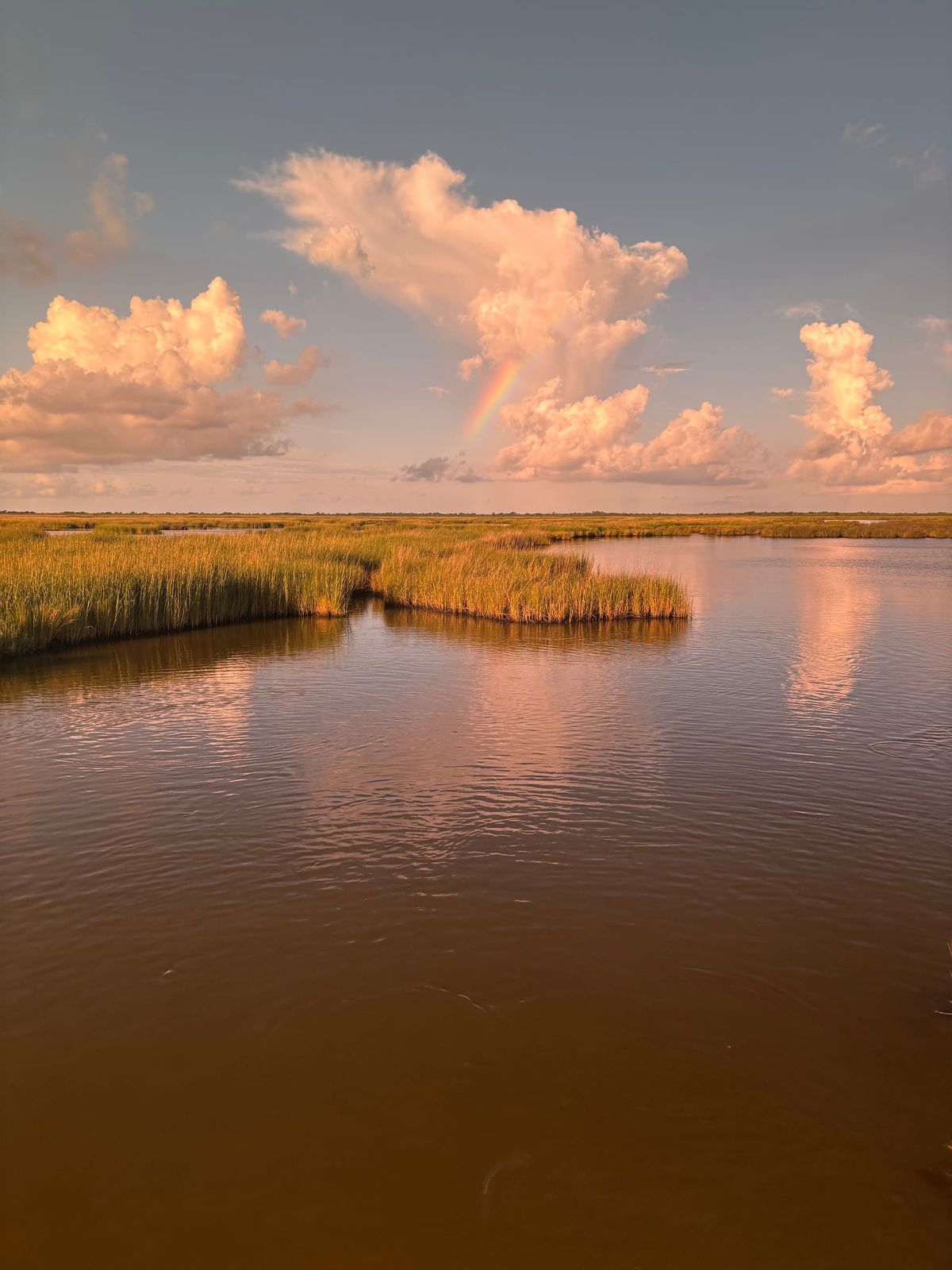
We work methodically and honestly, keeping a respectful distance from the shoreline of no more than twenty to twenty-five feet, as we still need to be able to pick apart every ledge, every clump of grass, and every oyster bed. Slow is smooth, and smooth is fast. I would be lying if I said there wasn’t every bit of thirty minutes that passed by without seeing a fish, totaling an hour of sweat, minor blood (sharp hooks are a double-edged sword), and no tears, thankfully. However, this shoreline soon dumps into a section of marsh with picture-perfect cover and exceptional water clarity, as far as Galveston is concerned. I can feel it, just like the tides turn, our luck has to as well.
Jbanks sneaks the skiff into the entrance, and just like flicking a switch, the marsh turns on. We hear blow-ups on blow-ups, the birds circle, and the mullet were doing their usual wake pushes that are always mistaken for redfish wakes out of the corner of your eye. As we push forward, I spot a tail to my right. With this being my first true spot of the day, I got the usual first-cast nerves. I pull it together, start my back cast, and one false cast later, I present my backhand cast just in front of the fish. He turns last second, and as I start my strip, he spooks from a charge. After a string of words that would make even the saltiest sailors do a double take, I reorganized my line, put my fly in my hand, and got ready for the next shot. Unbeknownst to me, fifteen feet in front of my skiff on my left-hand side, a considerable-sized redfish would appear. His back stuck out of the water as he shimmied over a shallow oyster bar; his movements resembled a male peacock strutting his feathers for a mate. I knew this was the moment; I couldn’t take any time to see if this fish is happy or not—a way to describe a fish’s demeanor as to how ready they will be to eat a fly, let alone decide where I should present to him.
Instincts and muscle memory take over as I sling my dumbbell-eye Convict Killer just past and in front of him. Bump…Bump…the water erupted as he turned on my fly in inches of water. I give him a healthy strip set, and we’re off to the races. Dodging abandoned crab traps and sharp, line-hungry oyster beds, I was finally able to play him to the boat after three or so minutes. Once I slipped my fly out of the corner of his mouth (a perfect set, might I add), I got a few nice pictures and a length, with a tail pinch, of course. Thirty-Seven Inches, certainly a healthy redfish, bound to be respected by even the finest of Louisiana Bull Red Purists. Although this was not my first spot tail, or even my biggest (it’s hard to beat a 46” bull), I was not ready for the thoughts this fish would evoke.
With my five minutes of fame on the bow now over, I began to reflect on what these marsh pumpkins mean to myself and others on a cultural level and their pivotal role in our ecosystems. As my push pole slides through my hands and I look around, I realize the true value of redfish. Not only are redfish regarded as one of the best fly rod fish, personally, I believe they would be the best if they could jump, but redfish have also amassed a cult following among conservationists, artists, and weekend warriors alike. I looked towards the expansive marshes and flats around me, which I’m convinced would not be nearly as conserved as they are now if redfish were not so popular. Maybe this is why I keep coming back, maybe this is the reason that I’m too distracted in class or spend too much money on gear. Simply a fish to many, however, to me, I see a gateway into preserving these marshes for future generations. I see a topic of discussion for like-minded anglers. I see explosive eats and a primal drive to enjoy the hunt. I’m still not sold on what brings me back; maybe it’s just the frustration from a missed fish that makes the next one feel monumental. I think that’s just called delayed gratification. Nonetheless, whatever mix of emotions, milestones, or good times that keep me coming back, I’m forever grateful for these orange fish. Truth be told, I believe I’m just trying to reason with “Redfish Season.”